How to Securely Manage and Recover Old Gmail Accounts for Marketing Without Risking Your Data
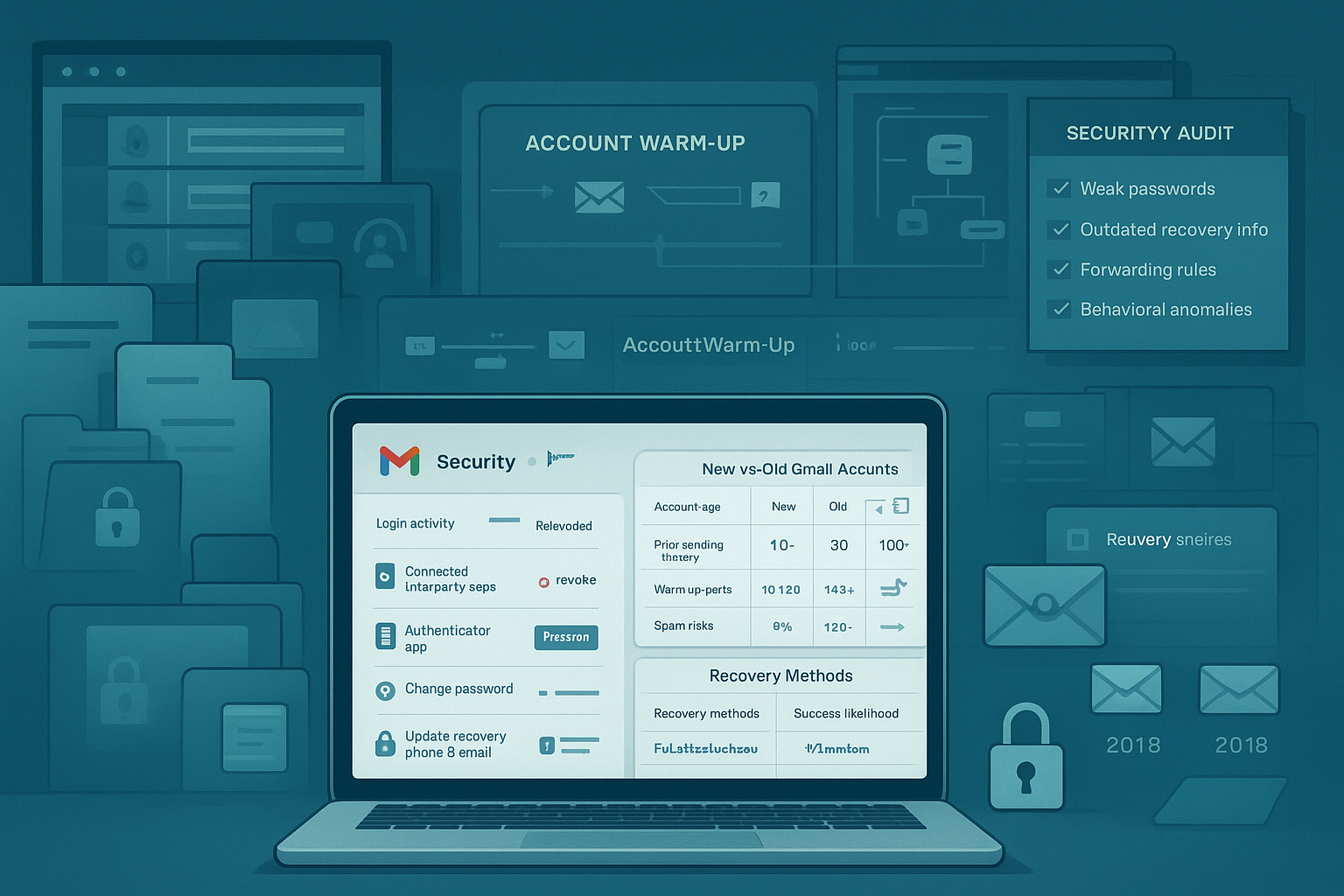
Sender reputation is not built overnight. Inbox providers evaluate dozens of signals before deciding where your email lands, and one of the most underestimated among them is account age. A Gmail account with years of legitimate activity behind it carries an implicit trust that a freshly created address simply cannot replicate. For marketers running cold outreach, lead generation, or multi-touch email campaigns, that difference can translate directly into deliverability rates - and revenue.
The challenge is that old accounts come with their own complexity. Dormant accounts accumulate security risks: outdated recovery information, forgotten third-party app permissions, stale passwords, and behavioral patterns that can trigger automatic lockouts the moment you start using them again. Marketers who explore options like purchasing an aged gmail account 2018 quickly discover that acquisition is only the beginning - what comes after requires careful, methodical handling to avoid losing both the account and the data connected to it.
This guide covers the full lifecycle: understanding why aged accounts matter, auditing and securing them properly, recovering access when something goes wrong, using them effectively in marketing operations, and building a long-term workflow that protects your campaigns and your data at every stage. The guidance here applies whether you are working with an account you created years ago or one you have recently acquired.
1. Why Old Gmail Accounts Have Unique Value for Marketing
1.1 Sender Reputation and Account Age Explained
Sender reputation is the composite score that receiving mail servers use to evaluate whether your emails should reach the inbox, land in spam, or get blocked outright. It draws from several layers of data: the sending domain, the IP address, and - critically in Gmail's case - the account itself. An account with a multi-year history of legitimate activity, real correspondence, and consistent behavior is treated very differently from a new address with no history at all.
When you send from a new account, inbox filters apply maximum scrutiny. There is no established pattern to evaluate, so any anomaly - a sudden volume increase, an unfamiliar recipient list, links in early messages - raises flags. An old Gmail account that has been active for several years starts from a position of relative credibility. That credibility does not make spam filters disappear, but it does reduce the friction at the early stages of outreach.
| Trust Signal | New Gmail Account | Old Gmail Account (3+ Years) |
|---|---|---|
| Account age | Days to weeks | Multiple years |
| Prior sending history | None | Established patterns of activity |
| Inbox filter scrutiny on first send | High | Moderate to low |
| Warm-up period required | Extended (4-8 weeks typical) | Shortened (1-3 weeks typical) |
| Likelihood of early spam classification | Higher | Lower, given clean history |
| Recovery options available | Limited (no prior device history) | More extensive (devices, patterns) |
1.2 Legitimate Marketing Use Cases for Aged Gmail Accounts
Not every use case for an old Gmail account in marketing is equivalent, and the distinction matters. The following scenarios represent common, practical applications where account age provides a genuine operational advantage:
- Cold outreach campaigns: Sending personalized prospecting emails to new contacts, where deliverability is directly tied to account credibility.
- Warm-up acceleration: Using an aged account as the foundation for a sending infrastructure that can reach productive volume faster than a new account allows.
- Segmented outreach by audience: Assigning specific aged accounts to specific audience segments or geographies to isolate sender reputation by campaign type.
- Team-based outreach systems: Distributing sending across multiple aged accounts within a team to stay within safe volume limits without creating a new-account bottleneck.
- Newsletter and announcement sending: Using an established address for regular subscriber communications where open rates and engagement history improve filtering outcomes.
1.3 Risks Marketers Often Ignore When Using Old Accounts
The value of an old Gmail account can evaporate quickly if the account's condition is not assessed before use. Dormancy creates specific problems that are easy to overlook. An account that has not been accessed in two or more years may have recovery information that no longer works - an old phone number, a deactivated backup email address - which becomes critical the moment something goes wrong.
Security settings that were adequate at the time of account creation may no longer meet current standards. Password practices have evolved, and a password set in 2016 is statistically more likely to have been exposed in a data breach. Third-party apps connected during earlier use may retain access permissions that the current account holder has forgotten entirely.
From a marketing standpoint, dormant accounts can also carry penalties with Gmail's sending infrastructure. Sudden high-volume sending from an account that has shown no activity for years is a behavioral anomaly that filtering systems are designed to catch. Understanding these risks before activating an old account for marketing is not optional - it is the prerequisite for everything else.
2. Understanding Gmail Account Security for Aged Accounts
2.1 Common Security Vulnerabilities in Old Gmail Accounts
Aged accounts accumulate vulnerabilities passively. The longer an account sits dormant, the more likely it is that the security configuration has drifted away from current best practices. The most consequential vulnerabilities to check for include:
- Weak or exposed passwords: Passwords created years ago are frequently simple by today's standards and may have appeared in credential leak databases. A compromised password on a dormant account can go unnoticed for months.
- No two-factor authentication: Many older accounts predate the widespread adoption of 2FA. An account without it relies entirely on password security, which is insufficient for any account used in a marketing operation.
- Unreviewed third-party app permissions: Apps connected during prior active periods - scheduling tools, CRM integrations, browser extensions - may still hold full access to the account. Any of these could represent an active vulnerability or a data privacy exposure.
- Outdated recovery contact information: A recovery phone number tied to a device you no longer own, or a backup email that has been closed, leaves you without a reliable path back into the account if access is ever interrupted.
- Stale forwarding rules and filters: Some compromised accounts are quietly configured to forward all incoming mail to an attacker's address. These rules persist even after the initial access event and are easily missed.
2.2 How Gmail Monitors Account Activity and Flags Risk
Gmail's automated security systems are designed to detect behavioral anomalies - patterns that diverge significantly from an account's established history. For an aged account being reactivated for marketing, several common behaviors can inadvertently trigger these systems.
Login from a new device or unfamiliar geographic location is one of the most consistent triggers, particularly when the account has been dormant. If the last login was from one city and the new login is from a different country, the system may prompt for additional verification or temporarily restrict activity. This is not a failure of the account - it is an expected security response - but it can interrupt a marketing operation at a critical moment if the marketer is not prepared.
Sudden volume increases in sending are another major flag. An account that has sent zero emails for eighteen months and then attempts to send two hundred in a single day is exhibiting exactly the pattern that spam infrastructure is built to catch. High bounce rates in early sends - which occur when list hygiene is poor - compound this problem rapidly. Each bounced message is a signal that the sender is not operating with a verified, consented recipient list, and filtering systems adjust accordingly.
2.3 Step-by-Step Gmail Security Audit for Old Accounts
Before using any old Gmail account for marketing purposes, complete a full security audit. This process should happen before any sending, before connecting any tools, and before changing any settings that cannot easily be reversed. Work through the following sequence in order:
- Review recent login activity: Access the account's security dashboard and check for any logins you did not initiate. Look for unfamiliar devices, locations, or timestamps. If you see activity that is not yours, treat the account as potentially compromised before proceeding.
- Audit connected third-party apps: Review every application that has been granted access to the account. Revoke permissions for any app you do not actively use or cannot identify. Pay particular attention to apps with access to read, compose, or send mail.
- Change the password: Replace the existing password with a strong, unique credential - at least sixteen characters, combining letters, numbers, and symbols, and not used on any other account. Use a password manager to store it securely.
- Enable two-factor authentication: Set up 2FA using an authenticator app rather than SMS where possible. Authenticator apps are more resistant to SIM-swapping attacks and are the recommended standard for accounts used in professional operations.
- Update recovery contact information: Confirm that the recovery email address is one you currently control, and that the recovery phone number is active and in your possession. Both should be current before you proceed with any marketing use.
- Review forwarding rules and inbox filters: Check the Filters and Forwarding section of the account settings. Delete any rules you did not create, and remove any forwarding addresses that should not be receiving copies of your mail.
- Check sent and draft folders for unauthorized content: Scroll through recent sent messages and draft folders for any content you did not write. Unauthorized sent mail is a strong indicator of prior account compromise and warrants a more thorough investigation before proceeding.
3. How to Recover an Old Gmail Account Without Losing Access or Data
3.1 Gmail's Official Recovery Methods and Their Limitations
Gmail account recovery follows a tiered process. The platform first attempts to verify identity using the most current recovery information on file. If a recovery phone number is attached to the account, a verification code is sent to that number. If a recovery email address is available, a reset link is delivered there instead. When neither is accessible, Gmail presents a series of questions based on account history - security questions for older accounts, or behavioral verification prompts based on prior activity.
For accounts where all standard recovery paths have been exhausted, an account recovery form allows users to submit additional context about their ownership. This process is not guaranteed and relies on Gmail's automated systems to evaluate the submitted information against account history. The likelihood of success varies considerably depending on how much verifiable ownership information the user can provide.
| Situation | Best Recovery Method | Success Likelihood | Key Requirement |
|---|---|---|---|
| Recovery phone still active | SMS verification code | High | Access to the registered phone number |
| Recovery email still accessible | Email verification link | High | Access to the backup email inbox |
| No recovery contact, trusted device available | Device-based verification prompt | Moderate | Access to a previously used device |
| Old password known, account locked | Prior password verification | Moderate | Accurate recall of a previous password |
| No recovery contacts, no trusted device | Account recovery form | Low to moderate | Detailed ownership information |
3.2 What to Do When Standard Recovery Fails
When the standard recovery flow does not result in access, the options narrow but do not disappear entirely. The first step is to try the process from a device and network that you previously used with the account - Gmail's systems weight behavioral consistency, and a familiar device or location can tip the verification outcome in your favor.
If the account has security questions set from an earlier era, providing accurate answers - even for questions that feel dated - can work as an additional verification layer. For accounts with a long history, Gmail may also accept the approximate month and year the account was created as a verification input.
Gmail support can be contacted for additional escalation, though the assistance available for personal accounts is more limited than for paid Workspace accounts. For Workspace accounts, an administrator has more direct tools to restore access.
Several mistakes consistently make recovery harder and should be avoided:
- Attempting recovery from too many devices in rapid succession, which can trigger additional lockout periods.
- Entering incorrect passwords repeatedly before attempting proper recovery - repeated failures lock the account temporarily.
- Submitting a recovery form with vague or inconsistent information; specificity is what the automated review system evaluates.
- Waiting too long to attempt recovery after noticing a problem, as some recovery windows are time-limited.
If access genuinely cannot be restored after exhausting all available paths, accept that outcome rather than attempting workarounds that could permanently disqualify the account from future recovery eligibility.
3.3 Protecting Your Data During and After Recovery
Before making significant changes to any old Gmail account - especially one that will be repurposed for marketing - export a full copy of the account's data using Google Takeout. This creates a downloadable archive of emails, contacts, calendar data, and other associated files. It takes time to prepare but provides a safety net if anything goes wrong during the transition.
After regaining access, check whether any emails or contacts appear to be missing. Unauthorized account activity sometimes involves deletion of sent mail or inbox content to cover tracks. If the account history shows gaps that do not match what you remember, treat that as a potential indicator of prior compromise.
Post-recovery, establish a clear data handling protocol before using the account for marketing. Keep a separate, current export of the account's contacts and any configuration settings. If the account is connected to marketing tools or outreach platforms, document those integrations so they can be reconstructed quickly if something fails. Gmail account recovery is much less stressful when you have already taken the precaution of knowing exactly what is in the account and where it is stored.
4. Safely Using a Gmail Account for Marketing - Setup and Best Practices
4.1 Account Warm-Up Strategy for Aged Gmail Accounts
Even an old Gmail account with years of legitimate history benefits from a structured warm-up period when it is being transitioned into active marketing use. The account's prior activity may have been personal correspondence - low volume, irregular timing, varied recipients. Shifting abruptly to marketing-volume sending is a behavioral change that filtering systems notice.
A warm-up strategy manages that transition by increasing send volume gradually, maintaining high engagement rates in early sends, and establishing consistent daily sending patterns before scaling. The goal is to make the new behavior look like a natural evolution of the account's history rather than a sudden operational shift.
| Week | Daily Send Limit | Types of Emails to Send | What to Monitor |
|---|---|---|---|
| Week 1 | 10-20 | Highly personalized outreach to engaged contacts | Open rates, bounce rates, spam complaints |
| Week 2 | 25-50 | Warm introductions, follow-up sequences | Reply rates, delivery confirmation |
| Week 3 | 60-100 | Broader outreach with verified, cleaned lists | Bounce rate trends, unsubscribe rate |
| Week 4+ | Gradual increase toward target volume | Full campaign sends with segmented lists | Deliverability rate, inbox vs. spam placement |
4.2 Gmail Sending Limits and Policy Compliance
Standard Gmail accounts are subject to a daily sending limit that applies to the total number of recipients, not just messages. This limit is substantially lower than what most marketers need for scaled campaigns, which is why many professionals opt for Google Workspace accounts under a custom domain, which carry higher limits and more administrative control.
Beyond volume, policy compliance requires attention to the content and consent underpinning your sends. Recipients of commercial email should have given some form of prior consent, and every message should include a functional unsubscribe mechanism and your sender identity. These are not just best practices - they reflect legal requirements in most jurisdictions where email marketing is conducted.
| Account Type | Daily Sending Limit (Approx.) | Custom Domain Support | Admin Controls Available |
|---|---|---|---|
| Personal Gmail | 500 recipients per day | No | No |
| Google Workspace (basic) | 2,000 recipients per day | Yes | Yes |
| Google Workspace (higher tier) | Up to 10,000 recipients per day | Yes | Yes, with enhanced controls |
4.3 Tools, Integrations, and Security Considerations for Marketing Setups
Connecting a Gmail account to a third-party marketing tool - whether for sequencing, CRM synchronization, or analytics - requires granting that tool some level of account access. The degree of access matters considerably. OAuth-based connections, which grant scoped permissions for specific functions, are preferable to configurations that require sharing your full login credentials with an external platform.
Before connecting any tool to an old Gmail account being used for marketing, evaluate the permissions that tool is requesting. A sequencing platform that needs permission to send mail on your behalf does not need permission to read, delete, or manage your entire inbox. Granting more access than a tool requires is a security risk that accumulates over time as tools are added and forgotten.
- Always use OAuth authentication when a platform supports it, rather than direct credential sharing.
- Review the permission scope of every connected tool before authorizing access.
- Revoke access for any tool you stop using - do not leave unused integrations connected indefinitely.
- Use a dedicated password manager to maintain unique credentials for every platform connected to your sending accounts.
- Periodically audit all connected apps in your account settings, not just when onboarding a new tool.
- Avoid connecting the same aged account to multiple competing tools simultaneously; this creates overlapping send behavior that can confuse tracking and flag accounts.
5. Buying Aged Gmail Accounts - What Marketers Need to Know
5.1 How the Aged Email Accounts Market Works
The aged email accounts sale market exists because account age is a resource that takes time to accumulate organically. Accounts in this market are typically created well in advance of sale, kept active through varying degrees of activity to build history, and then listed for purchase - often categorized by creation year, level of prior activity, and whether any associated recovery information is included.
Account age categories in this market generally correspond to how account history affects deliverability. An account created in 2018 or earlier carries a longer trust history than one created in 2021, which is reflected in how these accounts are priced and described. The practical implication is that older accounts offer a shorter warm-up requirement and a higher initial credibility baseline - though neither is a guarantee of performance.
What varies significantly between providers is the quality and consistency of the accounts offered. Some operate with transparent account histories and include full recovery access transfer; others provide minimal documentation and no recourse if an account fails shortly after purchase. Understanding this variance is essential before entering any transaction in this space.
5.2 What to Look for in a Reputable Aged Account Provider
Evaluating a provider in the aged email accounts sale market requires looking beyond price and account age. The following factors distinguish providers who operate with integrity from those who do not:
- Verifiable creation dates: The account's creation year should be demonstrable within the account itself, not just claimed in a listing.
- Prior sending history or clean inactivity: Accounts with no prior spam activity are preferable to those with ambiguous sending records. A clean but dormant account is generally safer than one with extensive but unverifiable prior use.
- Full recovery access transferred to the buyer: This means the recovery email, recovery phone number, or both should be updated to information the buyer controls. Without this, you cannot recover the account if you lose access.
- Clear replacement or refund policy: Accounts occasionally fail immediately after purchase due to platform-side detection. A credible provider stands behind their inventory with a documented policy for these cases.
- No shared or recycled accounts: An account that has been sold to a previous buyer and returned carries unknown history. Confirm that accounts are not resold.
- Verifiable reputation and buyer feedback: Look for documented reviews from prior buyers, not just testimonials on the provider's own platform.
5.3 Security Steps After Purchasing an Old Gmail Account
Taking ownership of a purchased account requires an immediate, thorough security transition. The seller had full access to the account until the moment of transfer, which means every credential and recovery path must be updated before you use the account for anything.
- Change the password immediately: Do not use the account under any credentials the seller provided. Set a new, strong, unique password as the first action after receiving access.
- Update recovery contact information: Replace the recovery email and phone number with your own current contact details. This is non-negotiable - if these remain in the seller's control, they can recover the account from you at any time.
- Enable two-factor authentication: Set up 2FA on the account using your own authenticator app or phone number immediately after updating recovery contacts.
- Run the full security audit from Section 2.3: Work through the complete audit checklist - connected apps, forwarding rules, sent mail review, login history - to establish a clean baseline before any marketing use.
- Verify the account's standing: Before sending anything, check that the account is not already under any restrictions by attempting a small, controlled test send and monitoring the outcome.
5.4 Legal and Platform Policy Considerations
The buying and selling of Gmail accounts is explicitly prohibited by the platform's Terms of Service. This is not a gray area - account transfer to another individual is not a permitted use, and accounts found to be in violation of this policy are subject to suspension without appeal.
This does not mean that the practice does not occur or that all purchased accounts are immediately detected. It does mean that marketers operating with purchased accounts accept a specific category of risk: the account can be suspended at any point without recourse, and no support pathway exists for accounts flagged for Terms of Service violations. Google support will not assist in recovering an account that was obtained in violation of platform rules.
For marketers considering this route, the practical consequence is that purchased accounts should never be treated as permanent infrastructure. They are operational tools with an uncertain lifespan, and any marketing operation built on them should include contingency planning for account loss. Do not store critical contact data, conversation history, or campaign assets solely within a purchased account. Operate as if suspension is possible at any time, because it is.
6. Building a Secure Long-Term Email Marketing Workflow with Aged Gmail Accounts
6.1 Ongoing Security Maintenance Checklist
Security is not a one-time configuration - it is an ongoing discipline. For marketers managing one or more aged Gmail accounts, the following maintenance tasks should be scheduled and repeated on a consistent basis:
| Task | Frequency | Why It Matters | Method |
|---|---|---|---|
| Review login activity | Weekly | Catches unauthorized access early | Account security dashboard |
| Audit connected apps | Monthly | Removes stale or unnecessary permissions | Account permissions settings |
| Update passwords | Every 90 days | Reduces exposure from credential leaks | Password manager |
| Verify recovery contacts | Every 90 days | Ensures recovery path remains functional | Account security settings |
| Export account data | Monthly | Provides backup if account is lost | Google Takeout |
| Review forwarding rules and filters | Monthly | Detects unauthorized configuration changes | Gmail settings, Filters section |
| Check deliverability performance | Weekly during active campaigns | Identifies reputation degradation early | Campaign analytics, bounce reports |
6.2 Structuring a Safe Multi-Account Marketing Operation
When marketing operations scale beyond a single account, structure becomes as important as security. Sending all outreach from one account concentrates risk - if that account is flagged or suspended, the entire operation stops. Distributing sends across multiple aged accounts, segmented by purpose, provides operational resilience and protects individual sender reputations.
- Segment accounts by campaign type: Use separate accounts for cold outreach, follow-up sequences, and newsletter sends. This prevents the behavioral patterns of one campaign type from affecting the reputation of accounts used for another.
- Assign accounts to specific audience segments: If you are reaching out to contacts in different industries or regions, dedicated accounts for each segment give you cleaner data and more controlled reputation management.
- Avoid cross-contamination of sender reputation: Do not use the same account for both high-volume cold outreach and personal correspondence with existing clients. The risk profiles of these activities are very different.
- Keep account credentials in a team password manager: For operations involving multiple people, ensure that credentials are stored securely and that individual team members do not maintain their own informal copies.
- Document every account's purpose, creation source, and connected tools: A simple internal record of what each account is used for and what tools have access to it makes auditing and incident response significantly faster.
6.3 Contingency Planning: What to Do When an Account Is Lost or Suspended
Account loss is a foreseeable event in any email marketing operation, particularly one that includes old Gmail accounts repurposed for outreach. Treating it as a foreseeable event rather than an unlikely disaster changes how you prepare for it.
The first layer of contingency is data redundancy. Every contact list used in a campaign should exist in a location entirely independent of the Gmail account - in a CRM, a spreadsheet, or a dedicated contact management system. If the account is suspended, the contacts and campaign history should remain fully accessible.
The second layer is replacement readiness. Maintain at least one aged account in a warm-up or low-activity state at all times, so that if a primary account is lost, a replacement can be moved to full operational use within days rather than weeks. This requires the foresight to keep accounts ready before they are urgently needed.
Gmail account recovery should also be part of the contingency plan, not an afterthought. If an account is suspended rather than permanently deleted, there is often a review or appeal process. Having current recovery contact information on file - verified recently, not just at setup - is what makes that process viable. An account whose recovery information was last updated two years ago is much harder to reclaim than one where the recovery path was confirmed last month.
Questions and Answers
How do I know if an old Gmail account has been compromised before I start using it for marketing?
Check the account's recent activity log immediately after access - this shows every login by device, location, and time. Also review the Sent folder, Drafts folder, and any active forwarding rules for content or configurations you did not create. If you find unfamiliar activity, treat the account as compromised, change all credentials, revoke connected app access, and complete a full security audit before using it for any outreach.
Can Gmail automatically suspend an old account just because it has been dormant for a long time?
Gmail can close inactive accounts that show no sign-in activity over an extended period - the threshold has been updated over time and currently applies to accounts with extended inactivity. The safest way to prevent dormancy-based closure is to log in periodically, even if no activity is taking place. Once you have confirmed you want to keep and use an account, establishing regular access will prevent it from being flagged as abandoned.
What is the safest way to transfer contact lists out of an old Gmail account before repurposing it?
Export your contacts through Gmail's built-in contacts export function, which produces a CSV file compatible with most CRM and marketing platforms. Also use Google Takeout to create a full account archive that includes emails, contacts, and associated data. Store the exported files in a location that is not dependent on the Gmail account itself - a local drive, a shared team folder, or a cloud storage service tied to a different account.
Is it possible to use a personal old Gmail account for marketing without converting it to a Workspace account?
Yes, but the limitations are significant. Personal Gmail accounts have a daily recipient cap that is far below what most marketing operations require, and they lack the administrative controls and custom domain support that professional outreach typically demands. For small-volume, highly personalized outreach - fewer than a few hundred emails per day - a personal old Gmail account can be sufficient. For anything beyond that, the constraints of a personal account create more problems than the account's age resolves.
What should I do if Gmail asks me to verify my identity when I try to use an old account for sending?
Complete the verification process before attempting to send anything further. Attempting to work around verification - by switching devices, using VPNs, or repeatedly retrying - can escalate the restriction. Follow the verification steps using the most current recovery contact information available. If the verification requires access to a phone number or email you no longer control, use the account recovery form and provide as much accurate ownership detail as possible.
How many aged Gmail accounts can a marketer safely manage without triggering platform-level scrutiny?
There is no published limit on how many accounts an individual can hold, but operating a large number of accounts from the same IP address, device, or browser session is a behavioral pattern that can draw automated attention. Managing multiple accounts is more sustainable when each account is accessed from a consistent, dedicated environment and used for distinct, non-overlapping sending activity. Using browser profiles, dedicated sessions, or separate devices for different accounts reduces the likelihood of accounts being associated and evaluated collectively.